
広告効果測定
同意した場合のみX Pixelを使用します。
メールアドレスや制作内容は送信しません。
Some content is automatically translated from Japanese. Untranslated sections are shown in the original language.
Project
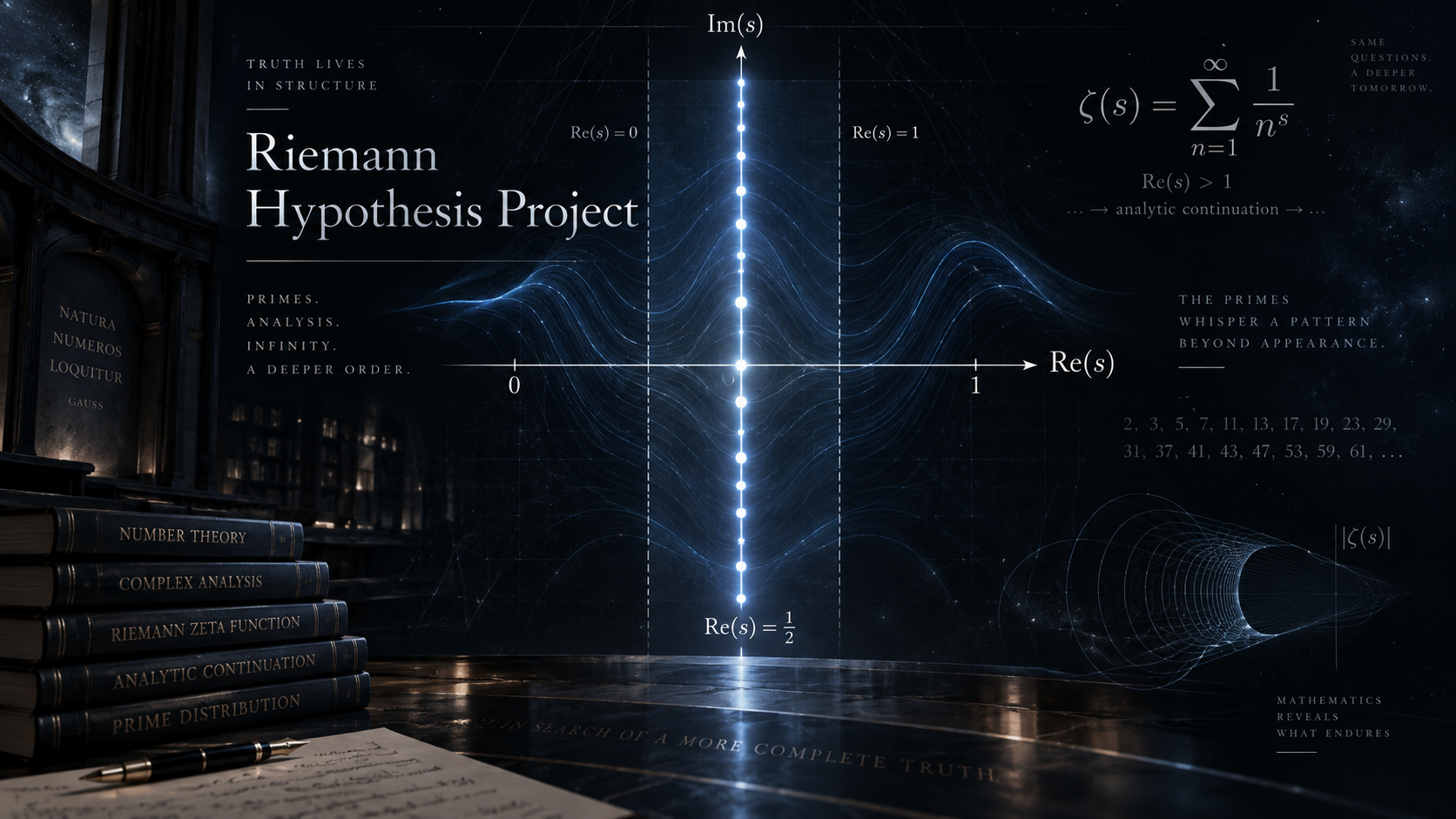
Challenging the Riemann Hypothesis through collaboration between humans and AI.
Last updated: Oct 25, 2026
We have shifted to leaving the selection and validation of research methods to Codex.
Support Yu Kanda's work from JPY 500.
Support Yu Kanda (Japanese)Conducting a performance evaluation of Codex while testing how far we can approach the proof of the Riemann Hypothesis. For organizing thoughts, we will utilize GPT-5.6 Explorer High, and for computation, exploration, and verification, Codex GPT-6 Astra Ultra will be employed. Rather than allowing the AI to solve it completely autonomously, we will guide the exploration direction by alternating between 'abstract structures' and 'mathematical structures,' combining human insights with AI's computational and exploratory capabilities. This will verify how far we can progress on unsolved problems through human-AI collaboration.
8 records · 6 production days
Although further research was conducted on the finite Weil, the two conditions necessary for proving the Riemann Hypothesis could not be resolved, and the matter was temporarily put on hold. Subsequently, I reconsidered fundamental issues, such as the structure of natural numbers, the nature of information, and what it would mean if the world were like a computer game. Ultimately, I arrived at the question of whether the Riemann Hypothesis is even a problem that can be proven with the current axioms of mathematics.
The structural theory of "displacement" did not reveal a direct bridge to the Riemann Hypothesis, leading us back to a frontal breakthrough with CMP and ES. Subsequently, I demonstrated a finite proposition that states if a strict even-odd order holds for actual finite Weil matrices, the simplicity of the lowest even state automatically follows. The main line toward the Riemann Hypothesis has been compressed to two conditions: "capture by the theta kernel" and "strict even-odd order" on the same co-finite sequence. The results have been reflected in the public research log, but the Riemann Hypothesis remains unresolved.
In the previous investigation titled "Do the two candidates originate from the same blueprint?", we were unable to demonstrate the connection. Thus, we returned to the process of how zeta is created from integers and the history of research, reconsidering our questions through my papers and the metaphor of smoke and spirals, exploring the underlying mechanisms behind the visible results using AI. We also examined proposals for providing an appropriate "measuring method for length" in the mechanism of choosing zeros, but we could not construct the necessary measuring methods, and we have not reached a proof.
Log in to comment.
Log in to comment (Japanese)Creators who are quickly testing what can be done with AI.
Consultations available → View the Creator page
A creation log platform that turns the process of taking on challenges into trust, connecting it to support, consultation, and transactions.
The simplicity and evenness of the Weil minimum state, as well as its agreement with the prolate approximation, have not yet been proven. Therefore, I further abstracted the problem and examined whether the completed zeta structure has a "mirror" that reflects left and right, and whether there is a mechanism that does not allow anything outside the critical line. However, it became clear that deriving this mechanism unconditionally leads back to the same barrier as the known Riemann Hypothesis. Furthermore, it became evident that even if another complete picture with the correct properties could be created, it does not necessarily mean it is the same as the actual zeta.
Since the last time, instead of simply following the equations, I have abstracted the structure multiple times by substituting it with elements like the resonance in the acoustic room, the collision between bullets, and the retrieval of narrative foreshadowing. Within this process, I reexamined the idea that "primes, Gamma, and theta are not separate forces, but instead emerge from the same singular zeta structure as a result of trying to satisfy all consistencies." I also confirmed, through known characterization theorems, that when certain conditions are simultaneously met, the zeta function is almost uniquely determined. Furthermore, by reviewing existing research, I realized that the finite test functions and the operator theory with fixed ranges I was trying to create could rely on established theorems. Consequently, I narrowed my remaining research focus to the "simplicity and parity of finite ground states" and the "comparison between actual ground states and the prolate approximation."

A business that connects job seekers and companies in real-time using AI.